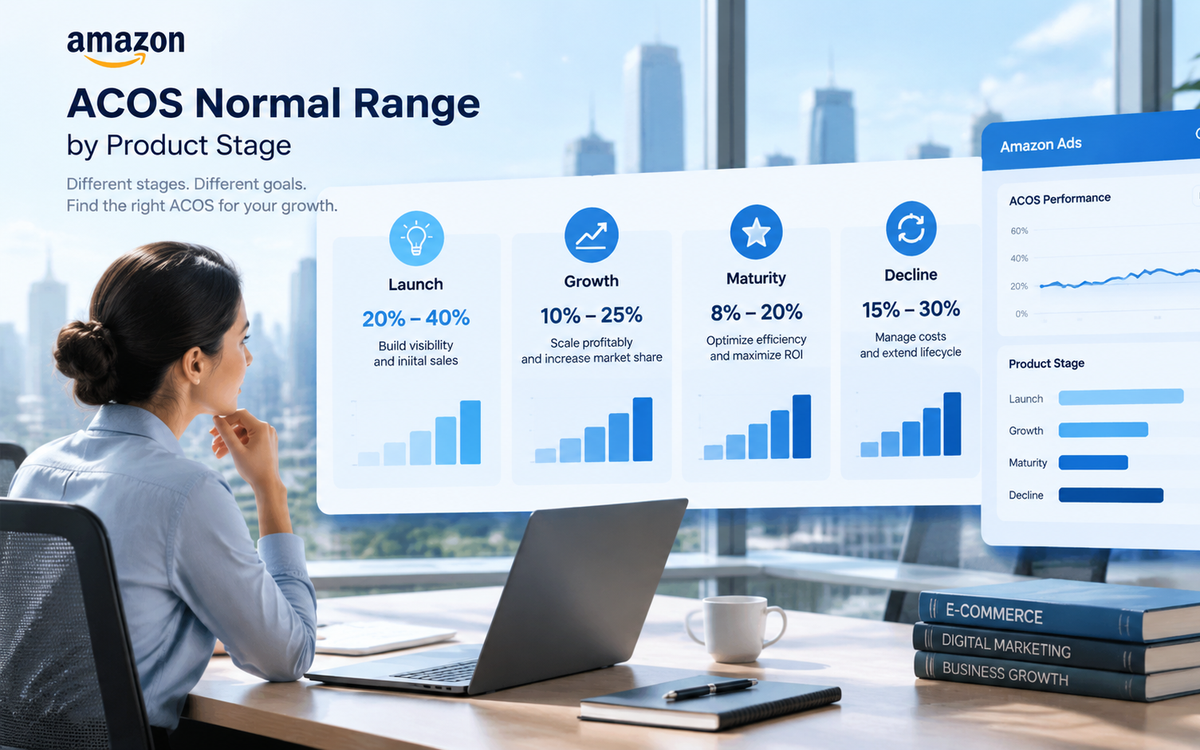
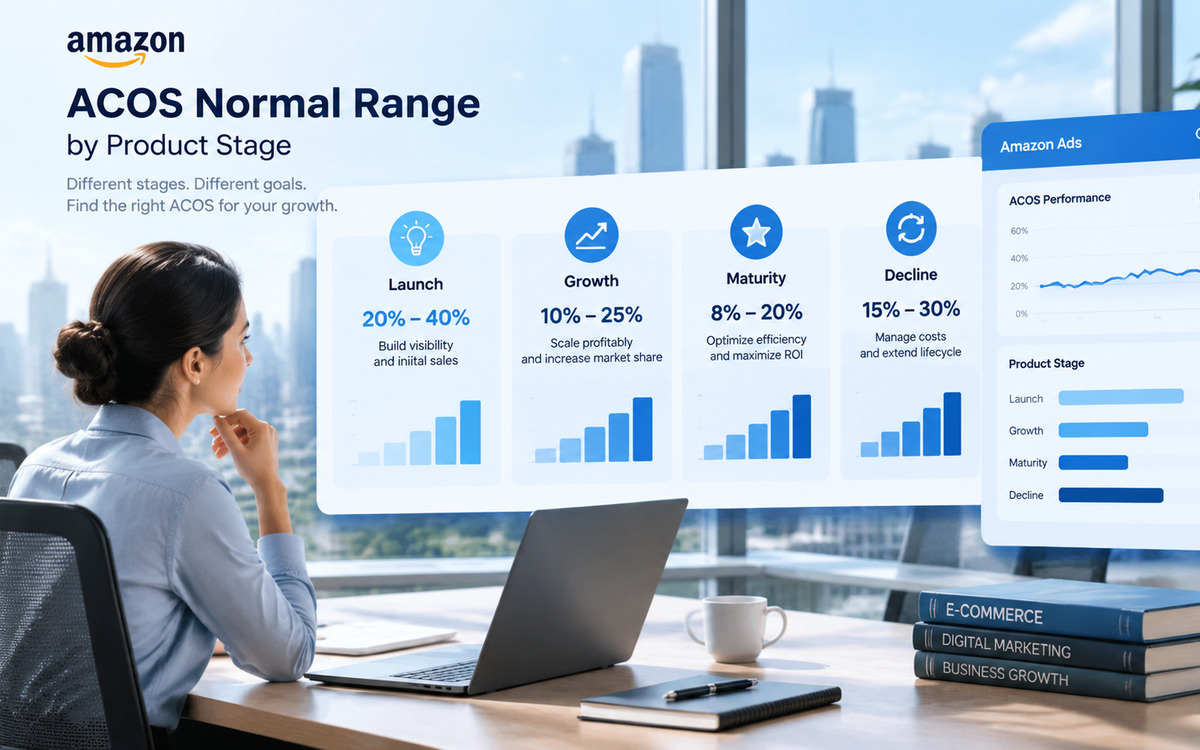
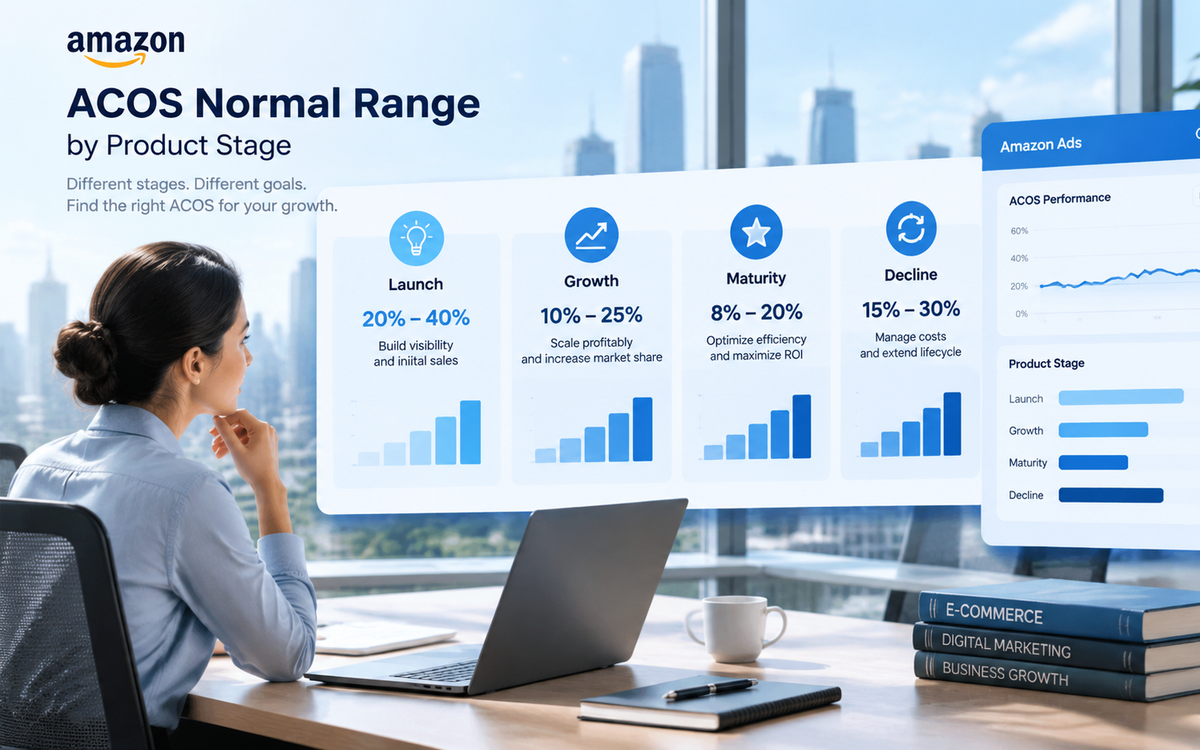
There is no one-size-fits-all “normal” ACOS on Amazon: mature, stable standard products typically run 15%-25%, non-standard products 25%-40%, and new product launches can see 30%-50% or higher and still be acceptable. The key to judging whether your ACOS is healthy isn’t the number itself—it’s whether it stays below your break-even ACOS (your gross margin) and whether it aligns with your current product stage goals.
What Is ACOS? How Does It Differ from TACOS and ROAS?
ACOS (Advertising Cost of Sale) is the most critical metric in the Amazon advertising console. The formula is:
ACOS = Ad Spend ÷ Ad-Attributed Sales × 100%
Example: If you spend $10 on ads and generate $50 in sales, your ACOS is 20%.
Looking at ACOS alone can mislead your assessment of ad performance, because it doesn’t reflect the ads’ contribution to the overall business. You need two additional metrics:
| Metric | Formula | Question It Answers |
|---|---|---|
| ACOS | Ad Spend ÷ Ad Sales | How efficient is the ad itself? |
| ROAS | Ad Sales ÷ Ad Spend (inverse of ACOS) | How much revenue does each $1 of ad spend generate? |
| TACOS | Total Ad Spend ÷ Total Sales | What share of the overall business comes from ads? |
Example: ACOS of 20% = ROAS of 5, meaning every $1 of ad spend generates $5 in sales. TACOS helps you judge the bigger picture: if total sales are $1M and total ad spend is $100K, TACOS is 10%, indicating ads are driving the business in a healthy way.
5 Factors That Determine What ACOS Is Normal for You
1. Category Competition
High-competition categories like consumer electronics and beauty have significantly higher CPC (cost per click) than home goods or outdoor categories. In competitive categories, naturally higher ACOS is normal.
2. Product Price Point and Gross Margin
High-ticket products (>$100) can sustain higher ACOS; low-priced products (<$20) need ACOS below 20% to remain profitable. The higher your gross margin, the higher ACOS you can afford.
3. Product Lifecycle Stage
New products need high ACOS to earn keyword rankings and organic placement; mature products should progressively lower ACOS to maximize profit.
4. Listing Conversion Rate
Conversion rate is the biggest lever on ACOS: double your conversion rate and ACOS drops by roughly half. If your listing isn’t optimized, no amount of ad spend will save it.
5. Ad Type
Auto campaigns are typically used for keyword discovery, so higher ACOS is normal. Manual exact-match campaigns should target lower ACOS. Sponsored Products (SP), Sponsored Brands (SB), and Sponsored Display (SD) each have different baselines.
Healthy ACOS Benchmarks by Product Stage
| Stage | Typical ACOS Range | Core Objective | Strategy Notes |
|---|---|---|---|
| New Product Launch | 30% – 50%+ | Rank building, data accumulation | Accept short-term high ACOS; watch keyword ranking velocity |
| Mature/Stable (Standard Products) | 15% – 25% | Steady orders, cost control | Gradually lower bids, optimize negative keywords |
| Mature/Stable (Non-standard/Apparel) | 25% – 40% | Maintain visibility and conversion | Use listing differentiation and brand terms to lower overall ACOS |
| Inventory Clearance | 50%+ acceptable | Recover cash flow | Prioritize breaking even over ad profitability |
These ranges are industry experience values, not official Amazon data. Your “normal” should be based on your own financials.
How to Calculate Your Break-Even ACOS
Break-even ACOS is the line that tells you whether your ads are profitable. The formula is simple:
Break-Even ACOS = Gross Margin (before ad spend)
Step-by-step example:
| Item | Amount/Ratio |
|---|---|
| Product Selling Price | $30 |
| Cost of Goods (incl. sourcing & freight) | $9 |
| Amazon Referral Fee (15%) | $4.50 |
| FBA Fulfillment Fee | $5 |
| Other Costs (storage, returns, etc.) | $1.50 |
| Gross Margin (before ad spend) | $10 (~33%) |
This means: as long as your ACOS stays below 33%, each ad-attributed sale is profitable. Above 33%, you’re losing money. Your break-even ACOS is 33%.
Practical Strategies to Lower ACOS
1. Keyword Optimization
- Move high-ACOS broad-match keywords to exact match
- Continuously add negative keywords to block wasted traffic
- Regularly download the search term report to find high-converting long-tail keywords
2. Bid Strategy
- Use dynamic bidding (down only) to reduce spend on wasted clicks
- Adjust bids by time of day: raise bids during high-conversion windows, lower them during low-conversion periods
- Gradually reduce bids on stable keywords to test profit headroom
3. Listing Conversion Optimization
- Main image: high resolution, highlight differentiators, stand out from competitors
- A+ Content: build brand trust and lift conversion
- Reviews: accumulate high-quality reviews—star rating directly impacts conversion
4. Campaign Structure Overhaul
- Organize campaigns into tiers: “exact keywords – broad keywords – auto discovery”
- Split high-performing keywords into standalone campaigns with concentrated budgets
- Regularly prune ad groups with “high spend, zero conversion”
How AI Agents Help Enterprises Automate ACOS Optimization
Traditional manual ACOS optimization relies on weekly report downloads, manual analysis, and manual bid adjustments—slow to respond and prone to missing anomalies. AI agents are changing this:
Real-Time Monitoring and Anomaly Alerts
AI agents monitor ACOS changes 24/7. When ACOS spikes beyond a set threshold (e.g., 50%), they trigger alerts and recommend bid reductions automatically, preventing budget waste.
Automated Bidding and Budget Allocation
Based on historical conversion data and the competitive landscape, AI agents predict optimal bid ranges and adjust bids automatically. They also dynamically shift budget from high-ACOS ad groups to low-ACOS, high-conversion groups.
Smart Negation and Keyword Discovery
AI automatically identifies “high-spend, zero-conversion” keywords and recommends negating them to cut wasted spend. It also mines high-converting long-tail keywords from search term reports and adds them to the right ad groups automatically.
Unified Strategy Across Sites and Ad Groups
Enterprise sellers often operate multiple sites and dozens of ad groups. AI agents execute optimization strategies consistently across all of them, keeping overall brand ACOS in a healthy range rather than optimizing in silos.
Enterprise Value
Moving from “manual weekly reports” to “AI real-time alerts + automated optimization” frees your operations team from day-to-day ad management, letting them focus on higher-value work like product selection, supply chain, and brand building.
FAQ
Is 50% ACOS normal for a new product?
Yes. New products need high ACOS to earn keyword rankings and organic placement; 30%-50% or even higher is acceptable. The key is setting a time window (e.g., 4-8 weeks) and then evaluating whether rankings have risen and ACOS is trending down.
How do ACOS and ROAS convert?
ROAS is the inverse of ACOS: ROAS = 1 ÷ ACOS. ACOS of 20% equals ROAS of 5; ACOS of 25% equals ROAS of 4.
How do I calculate break-even ACOS?
Break-even ACOS = gross margin (before ad spend). Calculation: Selling price − cost of goods − Amazon referral fee − FBA fulfillment fee − other costs = gross profit. Gross profit ÷ selling price = gross margin, which is your break-even ACOS.
Is high ACOS always bad?
No. High ACOS during a product launch is a necessary investment for rankings; high ACOS during inventory clearance is about recovering cash. The real test: is ACOS below your break-even line, and is the high ACOS translating into ranking gains and organic order growth?
Can AI tools replace human optimization?
AI agents excel at real-time monitoring, automated bidding, anomaly alerts, and repetitive optimization tasks—but they can’t replace strategic judgment (e.g., product selection direction, brand positioning). The best practice is “AI execution + human strategy”: AI handles daily tuning, humans make directional decisions.
Conclusion: Build a Profit-Driven ACOS Evaluation Framework
There’s no single “normal” ACOS. A healthy ACOS depends on your margins, product stage, category competition, and target TACOS. Instead of obsessing over “what’s everyone else’s ACOS,” calculate your own break-even ACOS first, then set stage-appropriate targets.
If your team is struggling with persistently high ACOS and inefficient ad optimization, visit markshuo.com to learn about AI agent ad optimization solutions—let the system monitor in real time, optimize automatically, and put every ad dollar to work.